

The Compute Rebellion
Why the Public Is Turning Against AI Before AI Has Fully Arrived

The Weightless Lie
How the Cloud Hid Its Body, and Why It No Longer Can
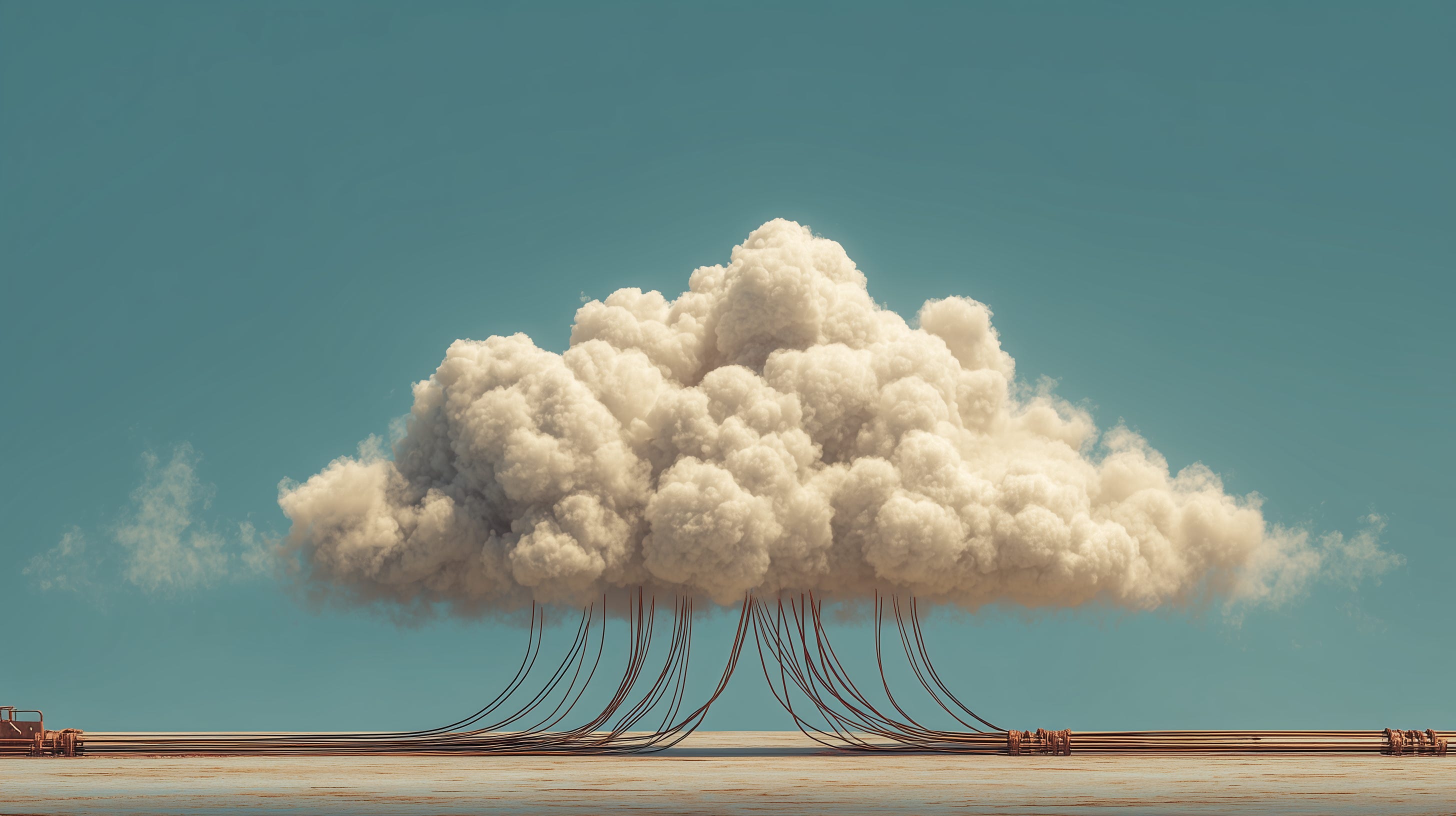
For about twenty-five years, the most powerful corporations on earth persuaded the public of a beautiful and useful lie: that computation happens nowhere.
The lie had a name, and the name was the cloud. It arrived gently, almost as a kindness. In 1999 a young company called Salesforce began advertising itself with a red circle slashed through the word “software,” promising that you would never again have to install, maintain, or even think about the machinery underneath your work. In 2006 Amazon launched Web Services and quietly began renting out the empty capacity of its server farms, and within a decade the phrase had drifted so far into ordinary speech that retirees were storing photographs of their grandchildren “in the cloud” without the faintest curiosity about where the cloud might be. The genius of the word was its weightlessness. A cloud is the least material object the sky offers. It has no address, no smokestack, no thirst. It floats. It belongs to everyone and to no one. To say that your data lived there was to say that it lived in a kind of secular heaven, untroubled by the grubby facts of electricity and plumbing and zoning law.
This was never an accident of language. The metaphor did real ideological work, and a small group of scholars spent the better part of two decades trying to say so. The cultural critic Tung-Hui Hu, in his 2015 book A Prehistory of the Cloud, traced the image back through the schematic diagrams of the early telephone system and forward into the Cold War bunkers that were later refitted as commercial data centers, and he argued that the cloud was always a political abstraction designed to conceal its own ground. We picture it as placeless and ethereal, Hu wrote, and yet the reality is embodied in thousands of enormous buildings, any one of which can draw as much power as a midsized town. Kate Crawford, in Atlas of AI, pushed the materialist case until it became almost unbearable to ignore: that what we call artificial intelligence is not a structure made of mathematics but a structure made of lithium pits in Nevada, cobalt in the Congo, container ships, undersea fiber, transformer yards, the labor of underpaid data labelers, and the steady draw of electrons from a grid that someone, somewhere, has to keep balanced. Nicole Starosielski made the same argument about the internet’s nervous system, mapping the brittle, contested, deeply geopolitical reality of the undersea cables that polite conversation prefers to forget.
For most of the cloud era these were minority reports. They circulated among academics and a thin population of infrastructure obsessives, the sort of people who can tell you which county hosts the most fiber and why. The general public felt none of it. That was the whole point. The lived experience of the internet remained, by careful design, frictionless and immaterial. You typed, the answer came, and the cost of the answer was charged to no account you could see. The machinery had been sent away to live in the desert and the exurbs, behind chain-link and shrubbery, and the public was free to enjoy the magic without ever meeting the magician.
Then came generative artificial intelligence, and the spell broke.
It broke not because anyone made a persuasive argument. It broke because the physical requirements of the new machines grew so suddenly and so violently that they could no longer be hidden behind a metaphor. The cloud, which had spent a quarter-century learning to be invisible, was dragged back into daylight as what it had always been: a vast and growing body of buildings and turbines and cooling towers and high-voltage lines, with a heartbeat you could hear from your bedroom and a thirst you could measure against your reservoir. This is the central fact of the present moment, and almost everything else in the politics of AI follows from it. Artificial intelligence is becoming the first major technology of the digital age whose hidden infrastructure is being forced, against the wishes of the companies that built it, back into the field of public vision. And a public that can see a thing is a public that can fight about it.
Consider the scale, because the scale is what changed. The International Energy Agency, an organization with no taste for melodrama, published its first full reckoning of energy and artificial intelligence in the spring of 2025, and the figures it assembled have the quality of a fever chart. Global data centers consumed something like 415 terawatt-hours of electricity in 2024, roughly one and a half percent of the world’s supply. By 2030, in the agency’s central case, that figure roughly doubles to about 945 terawatt-hours, a quantity slightly larger than everything Japan uses in a year. The growth is not evenly spread. In the United States it is concentrated almost grotesquely: data centers are on track to account for nearly half of all the growth in American electricity demand between now and the end of the decade. The agency’s executive director, Fatih Birol, offered a comparison that ought to be taught in schools. Within a few years, he observed, the United States will be using more electricity to process data than to manufacture aluminum, steel, cement, and chemicals combined. The country that once built the physical world will soon spend more current thinking than smelting.
A separate study from Lawrence Berkeley National Laboratory, prepared for the Department of Energy, sharpened the domestic picture. American data centers used 58 terawatt-hours in 2014 and 176 in 2023; by 2028 they are projected to consume somewhere between 325 and 580, which is to say between roughly seven and twelve percent of all the electricity the United States generates. One of the researchers described it, with the careful understatement of his profession, as the largest such increase in a very long time. That phrase deserves a moment. We are not talking about a brisk uptick in a mature industry. We are talking about a load growing faster than the grid was built to grow, in a country whose grid has not contemplated demand growth of this kind since the air conditioner and the suburb arrived together in the middle of the last century.
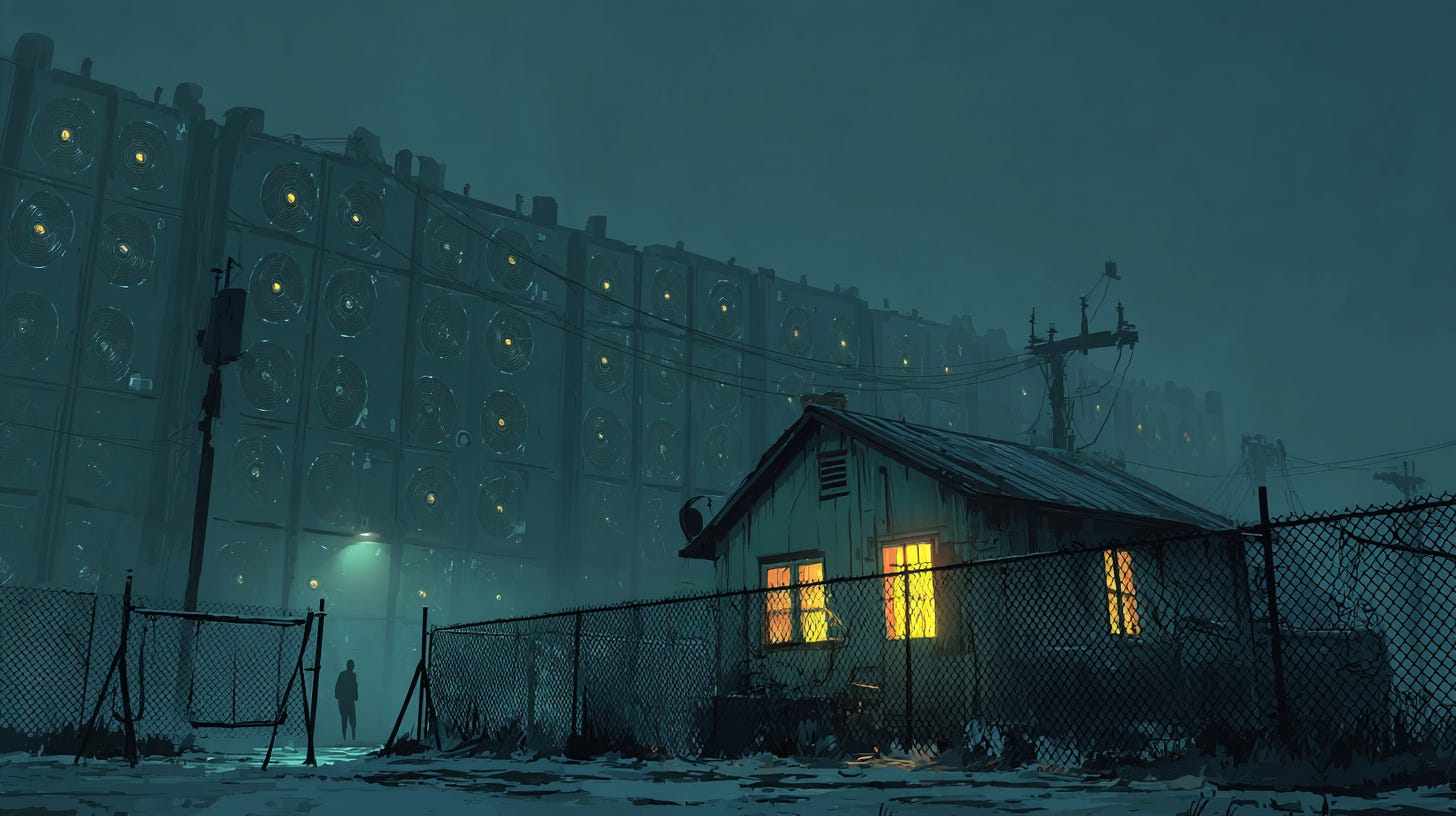
Numbers at this altitude tend to slide off the mind. So it is worth descending to the buildings themselves, because the buildings are where the abstraction finally acquires a shadow. An ordinary cloud data center of the older sort draws the power of perhaps ten to twenty-five thousand homes. The new machines built for training and running large AI models operate in a different register entirely. A single hyperscale AI campus can pull the equivalent of a hundred thousand households or more, continuously, day and night, without the seasonal mercy of a load that falls when people sleep. Meta’s planned Hyperion complex in Louisiana is engineered to demand more than twice the electricity of the city of New Orleans. The company’s Wyoming facility, by some accounts, will use more power than every home in the state of Wyoming combined. OpenAI’s Stargate campus rising outside Abilene, Texas, will eventually cover roughly 940 acres, which is to say it will be larger than Central Park, and at full build it is designed to draw as much as 1.2 gigawatts without pause, enough to keep the lights on in something like a million homes. These are not server closets. They are private cities of computation, and they consume like cities, and like cities they have to be put somewhere, near water and near power and therefore near people.
If you want a single image to hold the whole transformation, take the one the country has been handed, almost too perfectly, as a gift to anyone who writes about symbolism. In the autumn of 2024, Constellation Energy announced that it would restart a nuclear reactor at Three Mile Island and sell the entirety of its output, for twenty years, to Microsoft. Three Mile Island. The reactor next door to the one that partially melted in 1979 and became, for two generations of Americans, the very name of technological hubris and the patron saint of the anti-nuclear movement. The company has tactfully rechristened the site the Crane Clean Energy Center, and the 835-megawatt unit is scheduled to come back online as early as 2027, a year ahead of plan, after the federal government approved a billion-dollar loan to help it along. The most notorious shuttered reactor in American history is being raised from the dead to feed a machine that writes emails and summarizes documents. One could not invent a more pointed parable if one tried. The technology that was sold as the lightest thing humanity had ever made turns out to require the heaviest thing humanity knows how to build.
And here we arrive at the argument I intend to make, which I will state plainly now and defend at length later.
The real political conflict over artificial intelligence will not be settled where its champions and its critics have so far chosen to fight it. It will not be settled in the benchmark scores that obsess the engineers, nor in the product launches that obsess the press, nor in the manifestos about superintelligence and human extinction that obsess a certain kind of philosopher with a newsletter. Those debates are real, but they are conducted in a register most people will never inhabit. The conflict that will actually shape how this technology is permitted to grow is being conducted in a far older and far more democratic vocabulary. It is being conducted in the language of the electric bill, the water table, the property line, the zoning variance, the school budget, and the question every community eventually asks of anyone who shows up wanting to build something enormous next door: who decided this, and what do we get, and what does it cost us, and were we ever asked.
This is the language of infrastructure, and it is the oldest political language there is. Long before there were nation-states there were quarrels about whose field the road would cross and whose stream the mill would dam. What the architects of the cloud achieved, for one remarkable generation, was the temporary suspension of that quarrel. They built an industrial infrastructure of staggering scale and they convinced almost everyone that no such infrastructure existed. The achievement could not last, because the machines kept getting hungrier, and a hunger of this size cannot be kept secret. The body of artificial intelligence has become too large to hide. And the moment a body becomes visible, it becomes available to be touched, measured, resented, regulated, and refused.
The backlash now gathering across the United States and well beyond it is therefore not, as its detractors like to suggest, a spasm of irrational technophobia. It is not the cousin of the people who feared that trains at thirty miles an hour would suffocate the passengers. It is something both more ordinary and more important. It is the first sustained democratic response to the physical body of a technology that was specifically engineered to have no body in the public mind. The protesters in Memphis carry smartphones. The county supervisors voting down rezonings stream music and book flights and search the web like everyone else. They are not against computation. They are against being made, without their consent and frequently without their knowledge, into the host organism for someone else’s machine.
There is one further feature of this moment that gives the rebellion its peculiar charge, but it must be named at the outset because it shadows everything. The backlash is arriving early. It is arriving before the technology has delivered, to most ordinary people, anything resembling the transformation that was promised in exchange for all this disruption. When the railroads tore through the countryside in the nineteenth century, they at least left behind the visible miracle of speed; when the electrical grid marched across the land, it left behind light. Artificial intelligence is asking the public to pay the physical price of its infrastructure now, in real money on real bills and real water out of real rivers, while the consumer payoff remains, for the great majority, a chatbot that drafts a serviceable cover letter and a coding assistant whose productivity gains economists are still struggling to find in the data. The companies are spending on a scale that beggars description, hundreds of billions of dollars in a single year, betting the better part of their balance sheets on a future that has not yet announced itself. And they are funding that bet, at the margin, on infrastructure that the public can now see, hear, smell, and pay for.
That is a politically dangerous combination, and the danger is not hypothetical. It is already producing moratoriums, lawsuits, defeated incumbents, abandoned multibillion-dollar projects, and the resignation of borough councils in towns most Americans have never heard of. To understand why a technology can generate this much hostility before it has done most of us any visible harm, and what that hostility means for the decade ahead, we have to leave the altitude of the IEA’s charts and walk down to where the infrastructure actually meets the ground: to the substations and the cooling towers, the diesel generators and the trucked-in water, the hum that residents describe as an organ vibrating in the chest, and the meeting rooms where ordinary people have begun, with remarkable speed, to say no.
That is where we are going next.
The Body in the Backyard
Bills, Water, Noise, and the Communities Learning to Say No
The bill arrives once a month, and it does not float. Whatever else the cloud may have persuaded us to believe about the weightlessness of computation, the utility statement remains stubbornly material, a single number at the bottom of a page that the household must find the money to pay. It is the place where the abstraction is converted, with brutal arithmetic, into a question of whether to run the air conditioning in August. And across large stretches of the United States, that number has begun to move in a direction that ordinary people have correctly learned to associate with the buildings going up at the edge of town.
The clearest evidence comes from the largest wholesale electricity market in North America, the grid operator known as PJM, which keeps the lights on for sixty-five million people across thirteen states and the District of Columbia. Once a year, PJM holds an auction to secure the future capacity it will need, and the result of that auction flows downstream into the bills of nearly everyone it serves. In the auction that cleared for the 2025 and 2026 delivery year, the price leapt from twenty-nine dollars per megawatt-day to nearly two hundred and seventy, an increase of more than eight hundred percent in a single cycle. PJM’s own market monitor attributed the majority of that surge to the arrival of data-center demand, an addition of something like nine billion dollars in costs that the auction simply hands to the people who buy power. In western Maryland and across Ohio, residential customers can find the consequence printed on their statements as an extra sixteen or eighteen dollars a month, a line item for the privilege of subsidizing a load they did not request and cannot use.
The pattern repeats wherever the machines cluster. A locational analysis by Bloomberg found that wholesale electricity now costs as much as two hundred and sixty-seven percent more near significant data-center activity than it did five years earlier. Across seven mid-Atlantic states, utilities assigned more than four billion dollars in data-center connection costs to ordinary ratepayers in a single year. Step back from the regional detail and the national trend is unmistakable: household electricity rates have been climbing faster than commercial and industrial rates since the late 2000s, and dramatically faster since 2021, even though residential demand has grown more slowly than any other category. The Brookings Institution put the squeeze in plain figures, observing that electricity costs have risen forty-two percent since 2019 while overall consumer prices rose twenty-nine. That thirteen-point gap is not an abstraction. It is the difference between a paid bill and a disconnection notice, and the number of American households whose power was shut off for nonpayment climbed toward four million last year.
The industry, it must be said, contests every link in this chain, and not without ammunition. A white paper commissioned by Amazon argues that large new loads, far from raising rates, have historically lowered them for everyone else by spreading the fixed cost of the grid across more kilowatt-hours. Pacific Gas and Electric has projected that each gigawatt of new data-center demand could shave one or two percent off the average California household bill. In Mississippi, the chief executive of the local utility credits Amazon’s arrival with funding three hundred million dollars in grid upgrades that residents would otherwise have shouldered alone. These claims are not frauds. Under the right rate design, a giant customer with a steady appetite genuinely can underwrite improvements that benefit the whole system. The honest reading of the evidence is that data centers help ratepayers in some markets and hurt them badly in others, and that in the stressed corridors of PJM they are demonstrably doing the latter. Both things are true, and the political danger lives in the gap between them, because a family in Loudoun County watching its bill rise is in no mood to be told that a family in Mississippi is doing fine.
What gives the resentment its edge is not the dollar figure alone but the spectacle of who is asking the public to absorb it. In the opening weeks of 2026, the four largest builders of this infrastructure announced capital spending plans for the year that, taken together, approach three quarters of a trillion dollars. Amazon near two hundred billion, Microsoft near one hundred and ninety, Google around one hundred and eighty-five, Meta well above a hundred. Goldman Sachs expects the cumulative figure across just three years to exceed one trillion dollars, more than double the spending of the prior three. These companies are now devoting between forty-five and fifty-seven percent of their revenue to capital expenditure, a ratio that would have been considered deranged for a technology company a decade ago. When a citizen learns that Microsoft intends to spend a hundred and ninety billion dollars in twelve months and notices, in the same week, that her own electric bill has risen by twenty, she has not committed an error of economic reasoning. She has correctly perceived that the largest private construction program in living memory is being financed, in part, on the backs of people who will never own a share of it. The politics of that perception is already showing up at the ballot box. In Georgia last November, two sitting members of the Public Service Commission lost their seats after residential power rates rose forty-one percent in four years, turning what had reliably been the most somnolent election in the state into a referendum on who pays for the boom.
If the electricity story can at least be argued, the water story has proven harder to dress up, because water is something a community can watch disappear. A typical hundred-megawatt facility can drink up to two million liters a day, the daily consumption of several thousand households, much of it evaporated into the air for cooling and never returned. Researchers have begun to translate this into terms a layperson can feel. A modest exchange of prompts with a chatbot consumes a small cup of water somewhere upstream; a hundred-word answer, by one careful estimate, runs through roughly a bottle’s worth across its full life. These figures sound trivial until they are multiplied by the planetary volume of queries and the relentless growth of the buildings that serve them. A study out of the University of Houston projects that Texas data centers will consume forty-nine billion gallons of water this year and as much as three hundred and ninety-nine billion by 2030, a figure approaching seven percent of all the water the state uses. Nationally, by some accounts, two-thirds of the data centers built or planned since 2022 sit in places already classified as water-stressed.
The local episodes are where these projections stop being projections. In Fayette County, Georgia, an audit discovered that a data-center campus had been quietly running tens of millions of gallons through two improperly metered lines, drawing water it had never been billed for, at the precise moment the governor was declaring a drought emergency. In Tucson, the city caught a contractor obtaining a temporary construction-water meter inside the municipal limits and trucking the water out to a project the city had explicitly refused to serve, a maneuver of such transparent cynicism that it did more for the opposition than any pamphlet could have. The international cases are sharper still. In a parched suburb of Santiago, Chilean residents voted down a Google data center that proposed to draw from an aquifer already a decade into drought, and a court later forced the company to begin its permitting from scratch. In Uruguay, during the worst drought in seventy years, when the government in Montevideo had resorted to mixing salty water into the public supply, protesters gathered under a phrase that captures the whole grievance more precisely than any policy paper. No es sequía, es saqueo. It is not drought, it is plunder. They were objecting to a planned facility that would have consumed the daily water of fifty-five thousand people, in a country where the people were already being asked to drink the sea.
What recurs in every one of these fights is a single, ancient question wearing modern clothes. A town with a finite commons, increasingly the ordinary condition of a warming world, discovers that the entity proposing to draw it down is not a farmer with five generations of standing, not a hospital, not a school, but a corporation worth more than the country it has entered. The quarrel that follows is not really about computers at all. It is about standing, about who has the right to lay a straw into a shared well, and about the strange new fact that the thirstiest newcomer in the valley is an intelligence that does not drink.
Electricity is invisible and water is mostly invisible, but noise is the sense the machines cannot suppress, and it is noise that has done more than any chart to turn neighbors into activists. In a Chandler, Arizona neighborhood that sits within earshot of a facility opened in 2011, a resident named Karthic Thallikar describes a hum that runs without pause, around the clock, entering the bedrooms and the backyards and refusing to leave. A neighbor reports that she has not slept through a single night in two and a half years. Another likens it to a blender on steroids heard from a distance. The city eventually moved to ban new data centers across most of its territory, which tells you how persuasive a sleepless population can be when it appears, in numbers, at a council meeting. In Bristow, Virginia, a woman who lives near a Google complex told a national magazine that the load testing triggers her anxiety so badly she cannot sleep, that it rocks her to the core, that the vibration feels like an internal organ shaking and is one hundred percent unnatural. A reporter standing outside a facility in Sterling described an all-encompassing whoosh over a low rumble you feel in the body, the sound of a jet engine that never lands. The point is not the poetry of the complaints but their consistency, and the fact that researchers have begun to catch up to them. The first peer-reviewed health assessment of the Virginia data-center cluster, published early this year, found measurable grounds for concern, noting that round-the-clock background noise has long been associated with disturbed sleep, elevated blood pressure, and cardiovascular strain.
Behind the hum sits the diesel, the part of the story the brochures never mention. Virginia alone hosts something like nine thousand backup generators, the great majority of them diesel, several thousand in Loudoun County by itself. State analysts have estimated that in a worst-case scenario these machines could release nine thousand tons of nitrogen oxides, roughly half of everything that has typically poured from all sources in Northern Virginia in a year. A county supervisor put the lived reality more simply: the moment the generators fire, the complaints begin. After one substation failure, residents reported a sound, sustained for more than a day, that they could only compare to airplanes landing without end.
Nowhere has the collision of this infrastructure with an existing community been more concentrated, or more revealing, than in South Memphis, where Elon Musk’s xAI built a supercomputer called Colossus inside an abandoned appliance factory and set out to make it the largest training cluster on earth. To power it in a hurry, the company installed dozens of portable methane gas turbines, at first without air permits, leaning on an exemption written for genuinely temporary equipment. The public learned the true number only when an environmental law center commissioned a thermal flyover and counted the turbines from the air, because the elected officials who might have told them had signed agreements promising not to. The neighborhood downwind is Boxtown, a predominantly Black community where cancer rates run several times the national average and which already lived alongside an oil refinery, a steel plant, a gas plant, and the residue of a former coal facility. Lawyers estimated that the turbines could become the single largest source of smog-forming pollution in the city. A state representative who grew up in the area framed the matter at a rally without euphemism, pointing out that more children there are hospitalized for asthma than anywhere else in Tennessee, and that the community cannot pretend the cumulative weight of one polluter after another is anything but a deliberate arrangement. An official from the NAACP named the logic directly: the boom is hunting for places the country has already decided to sacrifice. When the county finally issued a permit, it covered only some of the turbines and treated the preceding year of unpermitted operation as if it had not happened. The appeal is ongoing. The federal environmental agency, having dismantled much of its own environmental-justice apparatus, is not expected to ride to the rescue.
Memphis is the rest of the country’s story compressed and sped up: extraordinary capital, deals the public was forbidden to see, a sacrificial geography chosen precisely because its residents were assumed to lack the power to refuse, and a regulatory structure that was already inadequate to the last industrial era and now faces a new one. And the most surprising thing about the present moment is how many communities, unlike Boxtown’s neighbors at the start, have turned out to possess exactly the power that was assumed to be missing.
The center of gravity in the AI debate has quietly migrated from international safety summits to the folding chairs of the county board hearing. In Loudoun County, the self-described data-center capital of the world, the supervisors voted to end the era in which such projects could be built essentially by right, requiring each one to run the gauntlet of public review. In neighboring Prince William, a judge invalidated the rezoning of a twenty-five-billion-dollar corridor that would have been the largest of its kind anywhere, and the county’s decision to abandon its appeal effectively buried the project. In Seattle, after a newspaper revealed that several companies were eyeing sites that together would consume a third of the city’s average power load, the mayor and three council members introduced an emergency moratorium and watched more than fifty thousand messages arrive from constituents within days. One councilmember offered a sentence that could serve as the movement’s epigraph, observing that water and land and air are life-giving resources and not entries to be shuffled around a balance sheet.
The fury reaches places far smaller than Seattle. In Archbald, Pennsylvania, a borough of about seven thousand people, residents discovered plans for six campuses totaling fifty-one buildings, each roughly the size of a Walmart, covering something like a seventh of the entire town, with hundreds of diesel generators sited within shouting distance of homes. Four of the seven members of the borough council resigned in protest within weeks. The mayor told reporters, with evident exhaustion, that the debate had destroyed the community and that no one could get a clear answer because everything was moving so fast. One departing council president warned, in a resignation letter, that his colleagues should put their families first and beware of the unstable passions the fight had unleashed. Maine, meanwhile, passed the first statewide moratorium on large facilities. A scattering of Georgia towns and Indiana counties have banned them outright. Microsoft was forced to scrap a Wisconsin project after the overwhelming majority of public commenters opposed it, and the company has since promised to stop binding municipalities to secrecy. Abroad the verdict is the same: Ireland choked off new connections around Dublin after its grid operator warned of blackouts, in a country where data centers now consume more electricity than all of its urban households together; Amsterdam imposed a moratorium that left the Dutch market permanently smaller; Singapore paused for three years before reopening on strict conditions.
The polling has caught up to the protests with startling speed. In Virginia, the share of voters comfortable with a new data center in their community collapsed from sixty-nine percent in 2023 to thirty-five percent by early 2026, and support for the lavish tax break the industry enjoys fell by a similar margin. Then came the national punctuation. A Gallup survey found that seventy-one percent of Americans oppose the construction of an AI data center in their local area, with nearly half strongly opposed. To put that figure in perspective, it exceeds the share of Americans who oppose nuclear power plants, the most stigmatized infrastructure of the past half-century. The opposition crosses the partisan divide as few things now do, uniting Democrats and Republicans in a country that agrees on almost nothing else.
There is one more fact that turns all of this resentment from a grievance into an injustice, and it concerns what the communities receive in exchange for what they give. The answer, with rare exceptions, is almost nothing. A typical large data center, once built, employs around fifty people, half of them contractors, to mind a building that may have cost billions. The watchdog group Good Jobs First, whose director has spent years cataloguing the deals, puts the matter bluntly: these are the most capital-intensive structures in modern industry, and once the construction crews leave, the number of permanent workers is vanishingly small. Yet the public subsidy lavished upon them is anything but small. Virginia’s sales-tax exemption for the industry, by the state’s own accounting the single largest economic-development incentive it offers, cost the treasury more than two and a half billion dollars over a decade and is on track toward two billion in a single recent year. School systems feel the absence directly, with one Northern Virginia district estimated to have forgone tens of millions in a single fiscal year. The director of Good Jobs First reduced the consequence to a sentence no politician wants to hear: the children, with their crowded classrooms, are the biggest losers.
Here, then, is the asymmetry that makes this moment unlike any earlier industrial boom. A steel mill of a century ago fouled the air, but it employed the town. An auto plant of the postwar decades brought smog, but it brought high wages and a union hall along with it. A hyperscale campus offers neither the jobs nor the wages, asks the public to absorb the rising bills and the falling water table and the unsleeping hum, and reserves the productivity, the data, and the political influence for itself. The community supplies the body. The company keeps the mind. Whether any society will tolerate that bargain for long, and whether the bargain might be rewritten before the rebellion hardens into something neither side can control, is the question I want to take up last.

The Ground Has a Vote
Why the Backlash Arrives Easy, and What It Will Force
A bargain that offers a community the costs of an industry and almost none of its rewards is unstable on its own terms, but communities have swallowed worse bargains before and called them progress. What makes this one different, what raises it from a grievance to something closer to an insult, is the timing. The public is being asked to pay the physical price of artificial intelligence now, in advance, while the benefit it was promised in exchange remains, for most people, a rumor.
This is the part of the story that the industry would most prefer you did not dwell on, and it is worth dwelling on. In the late summer of 2025, researchers associated with MIT released a study of how generative AI was actually performing inside the businesses that had rushed to adopt it. They examined hundreds of deployments and interviewed the executives running them, and the headline finding was difficult to soften: despite tens of billions of dollars in enterprise spending, ninety-five percent of the pilots had produced no measurable effect on the bottom line. Only one in twenty had generated significant value. The technology was not failing in some spectacular, smoking-crater fashion. It was simply not yet doing what the spreadsheets had assumed it would do. Around the same time, a careful experiment found that experienced software developers who used AI assistants and reported feeling around twenty percent more productive were, when their actual output was measured, roughly twenty percent slower. The feeling of acceleration was real. The acceleration was not. Other economists have observed that a large share of the time saved by these tools is promptly spent again on managing them, on coaxing and correcting and double-checking the machine, so that the net gain shrinks toward the margin of error.
None of this means the technology is a fraud or that it will remain a disappointment. The most candid voice on the subject has been Sam Altman’s. Asked over dinner with reporters whether investors had become overexcited about AI, the chief executive of OpenAI answered, in effect, yes, and added the historian’s observation that bubbles tend to form around a genuine kernel of truth. He is right on both counts, which is precisely what makes the present so disorienting. The country is pouring a share of its national output into information technology not seen since the dot-com mania, and the dot-com analogy cuts both ways, because the fiber and the data centers and the broadband laid down in that earlier frenzy of overinvestment did eventually become the productive bones of the modern economy, long after the stock prices that financed them had collapsed. It is entirely possible that we are living through the wasteful, indispensable infrastructure phase of something that will look, in thirty years, like a second electrification. But infrastructure politics does not unfold over thirty years. It unfolds over the billing cycle and the election cycle, and in that nearer horizon the equation a household confronts is simple and unforgiving. The bill is real today. The water is gone today. The hum is in the bedroom tonight. The transformation is a slide in someone else’s investor deck.
The two sides are not even speaking the same language, and the failure of translation is not accidental. Silicon Valley speaks in the grand register of transformation, of artificial general intelligence and the cure for cancer and a coming age of abundance in which scarcity itself is engineered away. Ordinary people speak in the older and more concrete register of the parcel and the bill and the well. When a company representative assures a family in Loudoun County that the windowless warehouse rising beside their subdivision is a step on the road to curing disease, the family is, in the meantime, watching its electricity rate climb and its property value stall and its school district forgo the tax revenue the building was exempted from paying. The mismatch is not a misunderstanding that better communication could fix. It is structural. One party is describing the destination. The other is being asked to pave the road, and to live next to it while it is paved.
To understand why the visibility of all this matters so enormously, and why a backlash should erupt now rather than at any earlier point in the long history of the cloud, it helps to borrow a pair of ideas from the people who have thought hardest about infrastructure. The sociologist Susan Leigh Star observed, in a much-cited essay from the end of the last century, that working infrastructure is by its nature invisible. We do not see the water main until it bursts, the bridge until it washes out, the grid until the lights go dark. Infrastructure becomes perceptible, she argued, chiefly at the moment of its breakdown, and even the backup systems we build to prevent breakdown only call further attention to the thing that has failed. For most of its life, the cloud was a triumphant illustration of Star’s principle in its quiet, functioning mode. It worked, and because it worked, no one saw it.
The anthropologist Brian Larkin complicated this picture in a way that turns out to describe our present with eerie precision. Invisibility, he wrote, is only one position on a much longer spectrum, a spectrum that runs from the entirely unseen at one end to the deliberate spectacle at the other, with every gradation in between. Infrastructure is never merely technical. It carries within it the desires and fantasies of the societies that build it, and at times those fantasies float almost free of any practical function, so that the thing becomes a kind of fetish, a monument to a civilization’s image of itself. A railway can be a way to move grain and also a poem about national destiny. A dam can irrigate a valley and also announce that a regime has arrived. The politics of a society can be constituted, Larkin argued, through the very form of the things it builds, through whether they are hidden or displayed and how.
The story of these past two years is the story of AI infrastructure sliding, with astonishing speed, from one end of Larkin’s spectrum to the other. For a quarter of a century the cloud lived at the invisible end, in the Star regime, working so smoothly that the public forgot it was there. Generative AI has hurled it to the opposite pole, into spectacle, into the Larkin regime. The campus outside Abilene is larger than Central Park and is discussed on the evening news. The turbines in Memphis have been photographed from the air and entered into the legal record. The resurrection of Three Mile Island is a national parable. Data-center heat plumes are now visible from satellites, and the chain-link perimeters of Loudoun County have become the subject of magazine features and documentary photography. This shift in visibility is not a matter of aesthetics. It is the precondition of politics itself. A thing that cannot be seen cannot be contested. The moment the body of AI became visible, it became available to the oldest democratic verbs there are: to measure, to question, to resent, to regulate, and to refuse.
Seen this way, the rebellion is not an aberration. It is the latest chapter in a story the United States has lived through many times, and the earlier chapters should chasten anyone tempted to dismiss the present one as mere hysteria. When the railroads carved up the American countryside in the 1880s, the farmers who organized against them were ridiculed as backward enemies of progress, and they went on to win the rate regulation that defined a generation of political economy. When high-voltage lines and power plants spread across the land, they met resistance that was condemned as ignorant and that nonetheless shaped the rules under which the grid was built. The anti-nuclear movement of the 1970s was treated by the technologically confident as a panic of the uninformed, and whether or not one believes it ultimately erred toward excessive caution, no honest observer can deny that it forced a regulatory architecture nuclear power had previously evaded. Fracking, wind turbines, cellular towers, the 5G rollout: each in its turn arrived as a sudden, visible imposition, each provoked a backlash, and each backlash was scorned in its moment and vindicated, at least in part, in retrospect, as the slow democratic work of asking who bears the costs of a thing and who collects its benefits and whether anyone bothered to ask the people in between.
The lesson of that long history is double-edged, and it is the most important thing the present combatants could absorb. Infrastructure backlashes almost never abolish the technologies they target. The anti-nuclear movement did not end nuclear power; it forced it to operate under conditions of consent it had previously assumed it could do without. The fracking fights did not end fracking; they produced bans in some states, real regulation in others, and a more honest national accounting of methane everywhere. The opposition to AI infrastructure will not abolish artificial intelligence, and anyone who imagines it might has misread the past. What it will do, almost certainly, is force a new settlement, a renegotiation of the terms on which the buildout is permitted to proceed.
Before I describe what that settlement might look like, fairness demands that the other side be given its strongest hearing, because there is a serious case for the buildout and pretending otherwise would be a kind of intellectual cowardice. The most powerful version of that case is geopolitical. Artificial intelligence is a strategic technology, perhaps the strategic technology of the century, and the bottleneck on its development is compute, and compute is built of exactly the data centers and power plants that the rebellion seeks to constrain. While the United States argues with itself over zoning, China added something on the order of four hundred gigawatts of new electrical capacity in a single recent year, a great deal of it wind and solar, building generation at a pace the American permitting system cannot approach. Eric Schmidt, the former head of Google, told a congressional committee that the power demands of AI are industrial at a scale he had never witnessed in his life, and warned that the country needs tens of gigawatts more within a few years. From inside this frame, throttling the domestic buildout does not reduce the global demand for compute by a single transistor. It merely relocates the compute, and with it the jobs and the strategic advantage and the political agency over the consequences, to somewhere less squeamish.
The second argument is that data centers, precisely because they consume so much power so steadily, can finance the modernization of a grid that badly needs it, spreading fixed costs across a larger base and underwriting investments that benefit everyone downstream. The same hyperscalers driving the rebellion are also driving the largest revival of American nuclear power in two generations and standing as among the largest purchasers of new renewable energy on the planet, with one of them adding eight gigawatts of clean power to its portfolio in a single year. The third argument is local and fiscal and undeniable on its own ground: in the handful of jurisdictions where the machines cluster most densely, the tax revenue is genuinely transformative, funding schools and roads and libraries on a scale that residents would sorely miss if it vanished. And the fourth argument is the technologist’s faith in efficiency, which is not mere faith but has history behind it, since data-center electricity consumption held remarkably steady for over a decade even as internet traffic multiplied many times over, thanks to relentless improvements in chips and cooling and architecture. The curve, on this view, will bend again, and AI’s footprint will grow far more slowly than its use.
These arguments deserve more than the reflexive dismissal they often receive from the movement’s louder voices. Taken together, however, they do not establish what the industry needs them to establish. They establish, at most, that the buildout may be necessary. They do not establish that its current distribution of costs and benefits is just, and it is the distribution, not the buildout as such, that has set the country alight. The most defensible position available to an honest observer is therefore not that AI infrastructure is good or that it is bad, but something more precise and more demanding. The buildout may well be a necessary investment in a strategic future. Its present allocation of who pays and who profits is, under the institutional arrangements we have inherited, close to indefensible. Repair the distribution and the politics will improve. Refuse to repair it, and the politics will get steadily, and deservedly, worse.
The shape of the repair is already visible in the early legislation, for those willing to look. It will involve separate rate classes for enormous customers, so that the cost of the capacity they demand is charged to them rather than smeared across every household on the line, an approach Oregon has already written into law and that dozens of utilities have begun to adopt. It will involve mandatory disclosure of water consumption, with real audits, in a country where a campaign can be undone by the discovery of an unmetered pipe. It will involve binding noise standards measured at the property line and meaningful setbacks from homes and schools, now that the medical literature has begun to confirm what the sleepless neighbors already knew. It will involve an end to the practice of binding local officials to secrecy, a practice so corrosive to democratic land-use review that even Microsoft has been forced to renounce it. It will involve the sunsetting or the conditioning of the lavish tax exemptions that have drained public budgets while delivering a handful of jobs, and it will involve a reallocation of grid costs by the federal regulators who have so far permitted the largest customers to socialize their burden onto the smallest. None of this is exotic. All of it is the ordinary machinery by which a democracy domesticates a powerful new industry, the same machinery that was eventually brought to bear on the railroad and the refinery and the reactor.
What the rebellion will not do, and what it would be a category error to demand of it, is supply a coherent and positive vision of how an intelligent society ought to be built. That is not the office of a backlash. A backlash does not design the future. It negotiates the terms of consent for a future that powerful actors have already begun to impose without it, and it does this work through the unglamorous instruments of the lawsuit, the moratorium, the rezoning, the ballot, and occasionally the mass resignation of a borough council in a town of seven thousand people. To ask the rebellion why it has not produced a blueprint for utopia is to misunderstand what it is for. It is for slowing the imposition down to the speed of consent.
There is a final thing to say, and it is the largest. For twenty-five years the most powerful enterprises in human history sold a fantasy of weightlessness, the fantasy that computation happens nowhere and costs nothing and is the nearest thing modernity has produced to a force of nature. That fantasy is now finished. It did not collapse because a critic refuted it or a court struck it down. It collapsed under its own physical weight, because the machines grew so vast and so thirsty and so loud that no metaphor on earth could keep them invisible any longer. The body of artificial intelligence has stepped into the daylight. Its appetite is visible, its exhalations are visible, its thirst and its hum and its true price are visible, and a public that can finally see the thing is responding exactly as publics have always responded to infrastructures with bodies, with hearings and lawsuits and the stubborn democratic refusal to host what they were never asked to host.
This is the meaning of the Compute Rebellion, and it is why I have insisted from the first page that it is not a war against intelligence. The people fighting it are not Luddites and they are not afraid of the future. They carry the same phones and run the same searches as everyone else. What they are refusing is narrower and more reasonable than their opponents pretend, and far harder to argue with once it is stated plainly. They are refusing to become the silent host organism for a machine whose mind will belong to someone in another state and whose costs will belong to them. They are insisting, in the oldest political language there is, that infrastructure of this magnitude is something a community grants rather than something a company takes, and that the granting requires being asked.
Artificial intelligence was sold as a cloud. It has turned out to be a body, and the body has a home, and the people who live in that home have begun to speak. Whether the companies building the future can learn to hear them, and to ask before they build, will decide far more about the next decade of this technology than any benchmark, any model, or any manifesto. The rebellion is not against the mind. It is against being made, without consent, into the mind’s ground. And the ground, it turns out, has a vote.
Reference Materials
Primary source material includes the International Energy Agency’s Energy and AI report and its executive summary (April 2025) and the remarks of IEA executive director Fatih Birol; the Lawrence Berkeley National Laboratory’s 2024 United States Data Center Energy Usage Report prepared for the Department of Energy, and the commentary of researcher Arman Shehabi; the Virginia Joint Legislative Audit and Review Commission’s Data Centers in Virginia study (December 2024) and the testimony of associate director Kimberly Sarte; Good Jobs First’s Cloudy with a Loss of Spending Control (April 2025) and earlier megadeals analyses, with the commentary of executive director Greg LeRoy; the MIT Project NANDA report The GenAI Divide: State of AI in Business 2025 (August 2025); the Houston Advanced Research Center and University of Houston water-consumption white paper (2025); World Resources Institute estimates of data-center water demand; Neha Gour and colleagues’ peer-reviewed health assessment in Frontiers in Climate (February 2026); the arXiv preprint “The Unpaid Toll: Quantifying and Addressing the Public Health Impact of Data Centers” (2024); PJM Interconnection capacity-auction results and the analyses of its Independent Market Monitor; Constellation Energy’s SEC Form 8-K announcing the Three Mile Island restart (September 2024) and the Department of Energy loan documentation (November 2025); the Southern Environmental Law Center’s thermal-flyover findings and legal filings concerning xAI’s Memphis facility; Eric Schmidt’s testimony before the House Committee on Energy and Commerce (April 2025); McKinsey’s The Cost of Compute (April 2025); the Amazon-commissioned Energy + Environmental Economics (E3) white paper and Edison Electric Institute–funded Charles River Associates studies; the Metr software-developer productivity study and Anders Humlum’s research on time displacement in LLM use; and Sam Altman’s August 2025 remarks on the AI investment cycle. Polling and survey data are drawn from Gallup (March 2026), the Pew Research Center (November 2025), and the Washington Post–Schar School poll of Virginia voters (March 2026). Foundational books and essays include Tung-Hui Hu’s A Prehistory of the Cloud (2015), Kate Crawford’s Atlas of AI (2021), Nicole Starosielski’s The Undersea Network (2015), Susan Leigh Star’s “The Ethnography of Infrastructure” (1999), and Brian Larkin’s “The Politics and Poetics of Infrastructure” (2013). Journalism and reporting consulted include coverage from Reuters, Bloomberg, The New York Times, The Washington Post, The Atlantic, The New Yorker, Wired, the Financial Times, CNBC, and S&P Global, alongside Heatmap News, Grist, Spotlight PA, Virginia Mercury, VPM, WRIC, Virginia Business, U.S. News & World Report, the Austin Chronicle, Tom’s Hardware, Data Center Dynamics, The Hill, the Winchester Star, the Spokesman-Review, Yale Climate Connections, the Brookings Institution, ABC15 Arizona, WPR, WNEP, and WVIA, with additional documents and reporting current to May 2026.
Theoretical framing draws on the infrastructure studies of Susan Leigh Star, Geoffrey Bowker, Brian Larkin, Lisa Parks, Nicole Starosielski, Shannon Mattern, Ashley Carse, and Penny Harvey and Hannah Knox; the materialist analyses of the cloud and computation in Tung-Hui Hu, Steven Gonzalez Monserrate, Mél Hogan, Andrew Blum, Ingrid Burrington, and James Bridle; the critical study of artificial intelligence in Kate Crawford, Vladan Joler, and Karen Hao; the energy humanities of Imre Szeman, Dominic Boyer, Cara New Daggett, and Timothy Mitchell; the histories of technological systems and their reception in Lewis Mumford, Thomas P. Hughes, David E. Nye, Ruth Schwartz Cowan, and Wiebe Bijker; Langdon Winner’s work on the politics of artifacts; the environmental-justice tradition of Robert D. Bullard, Steve Lerner, and Kyle Powys Whyte; the land-use and siting scholarship of William Fischel and Michael Dear; Elinor Ostrom on the governance of common-pool resources; Albert O. Hirschman on exit, voice, and loyalty; James C. Scott on legibility and the state; Ulrich Beck on risk society; and the work of Vaclav Smil on the scale and materiality of energy. Historical precedents of infrastructure backlash are informed by the literatures on Gilded Age railroad regulation and the Granger movement, rural and urban electrification, the American anti-nuclear movement after Three Mile Island, the hydraulic-fracturing disputes of the 2000s, and the contests over wind siting and cellular and 5G deployment.
A truly illuminating and balanced article, the trademark of the house. The connection with nuclear energy is particularly relevant. There is a clear risk that the backslash freezes in a take no prisoners refuse as it was the casa with NE and the tech is seriously harmed or delayed. While one could argue that the (perceived) risks are less significant than in the case of nuclear the insistence of both the press and the tycoons of impeding doom may actually make the tech more feared than NE contributing to a long-term opposition.
I keep a pair of wire cutters handy on my desk to use in an emergency.😀