

The Cartographic Lag
Why Power Is Reading a Map of a World That No Longer Exists

The Map That Made the Century
On the evening of January 25, 1904, a forty-two-year-old Oxford geographer named Halford Mackinder stood before the Royal Geographical Society in London and read a paper with the unassuming title “The Geographical Pivot of History.” The room was full of the kind of men the nineteenth century had produced in quantity and was about to stop producing: explorers, colonial administrators, surveyors of coastlines that no European had charted before. Mackinder himself belonged to that world. Five years earlier he had become the first European to reach the summit of Mount Kenya, an expedition that cost the lives of two of his porters and that he described afterward with the unbothered brevity of his era. He was, in other words, a creature of the age of exploration. And he had come to the Society that January evening to announce that the age of exploration was over.
For four hundred years, Mackinder argued, the story of power had been a story of expansion into unclaimed space. He called this the Columbian epoch. Europe had spilled outward across oceans and continents, and every political pressure generated at the center could be discharged at the periphery. There was always somewhere else to go, some blank space on the map into which ambition, population, and violence could be exported. Now the blank spaces were gone. The map was full. The world had become, in his phrase, a closed political system, and in a closed system nothing dissipates. Every explosion of social force, he warned, would henceforth echo around the globe and return to its point of origin. Weak elements in the political and economic organism of the world would be shattered rather than bypassed.
Then came the argument that would outlive him. In a closed world, geography itself becomes the deep grammar of power, and the grammar had a subject. The vast interior of Eurasia, unreachable by sea power, historically protected by sheer distance and traversable only by horse, was being stitched together by railways. Whoever organized that interior, the pivot area, would command resources on a scale no maritime empire could match. The sea powers that had ruled the Columbian epoch, Britain above all, occupied a ring around this pivot, an arc of coastal lands and islands that Mackinder’s successors would come to call the rimland. History, he suggested, could be read as a perpetual struggle between the interior and the ring: land power surging outward, sea power holding the line. Fifteen years later, writing in the shadow of Versailles, he compressed the thesis into the most quoted incantation in the history of strategy. Who rules East Europe commands the Heartland. Who rules the Heartland commands the World-Island. Who rules the World-Island commands the world.
It is worth pausing on what kind of object Mackinder had actually produced that evening, because it was not, despite appearances, a theory. It was a map. Not a paper map, but something more durable: a mental projection of where power lives, a way of looking at the surface of the earth and seeing significance distributed across it, dense here, thin there. Theories are argued with. Maps are steered by. And for the next hundred years, an astonishing share of the human race would be governed, armed, taxed, drafted, and occasionally incinerated according to the map a mountaineering geographer sketched in a gaslit lecture hall while the audience, according to the minutes, raised polite objections and went home.
The afterlife of the lecture is one of the strangest stories in intellectual history, stranger for how rarely it is told as a single story. In Munich in the 1920s, a retired general named Karl Haushofer built an entire discipline, Geopolitik, on Mackinder’s foundations, and taught it to a circle that included Rudolf Hess; through that channel a distorted echo of the pivot thesis reached the man who would eventually launch the largest land invasion in history, aimed, as it happened, directly at the heartland. In New Haven in 1942, the Dutch-American strategist Nicholas Spykman inverted the emphasis, arguing that the rimland, not the heartland, was the true prize, and that American security required permanently denying any single power control of Eurasia’s coastal margins. Spykman died the following year, but his inversion became, almost line for line, the blueprint of American grand strategy. Containment was the rimland thesis with a budget. NATO was the rimland thesis with an army. The alliance system that the United States assembled after 1945, that great arc running from Norway through Germany, Turkey, the Gulf, and onward to Japan, is Spykman’s map poured into concrete and treaty law. The domino theory that carried the United States into Vietnam was the map read nervously. The Carter Doctrine, which committed American force to the Persian Gulf, was the map read literally. Brzezinski’s grand chessboard was the map read lovingly, one last time, at the very moment the board was dissolving.
This is what maps do that theories cannot. A theory must be periodically defended. A map only has to be printed. Once a picture of where power lives gets institutionalized, it stops being an argument and becomes an inheritance, passed down through staff colleges and budget lines and the load-bearing metaphors of editorial pages. Bases are built where the map says the terrain matters. Careers are made studying the regions the map shades darkest. Intelligence agencies organize their desks by its provinces. The map begins as a compression of reality and ends as a constraint upon it, because eventually the institutions built on the map generate the very confrontations the map predicted, in the places it predicted them, which is then taken as proof of the map’s wisdom. There is no feedback loop on earth more elegant, or more treacherous.
And here we arrive at the actual subject of this essay, which is not geopolitics. Geopolitics is merely where the pathology is currently most advanced and most dangerous. The subject is the pathology itself, a structural condition that afflicts every steering system humans have ever built, from empires to central banks to corporations to individual lives, and that has no common name. Call it the cartographic lag: the interval during which a representation of power outlives the world it was drawn to describe.
The lag is not the same thing as error. All maps are wrong in the trivial sense; compression is the entire point of a map, and compression discards truth by design. A map that discarded nothing would be the territory, and useless. The lag is something more specific and more interesting. It is the phase in the life cycle of a representation when the world underneath it has structurally changed, when the quantities the map measures are no longer the quantities that matter, but the map’s authority remains intact, because authority is social and decays on a completely different schedule than accuracy. Accuracy dies with the territory. Authority dies with the generation that was trained on the map, and usually not before.
Every domain of organized life has its fossil record of lags. Ptolemy’s Geography, recovered by the Latin West in the fifteenth century, understated the circumference of the earth by a quarter; Columbus trusted the error, which is why he sailed, and why he died insisting he had reached Asia. Interwar central bankers restored the gold standard at prewar parities because gold was the monetary map on which every one of them had been raised, and they steered the world economy by it straight into the abyss; the map said discipline, the territory said deflation, and the map won until the territory took its revenge. France in the 1930s possessed a superb representation of the Great War and built it, at ruinous cost, in concrete along its eastern frontier, a museum of the previous conflict masquerading as a defense against the next one. In each case the fatal element was not ignorance. The bankers were brilliant; the French general staff had studied war more rigorously than any institution alive. The fatal element was that brilliance had been invested in the map rather than the territory, and past a certain point of investment, evidence against the map registers as noise, or worse, as heresy.
The most instructive case, because it is the most recent and the best documented, is the death of the Soviet Union, which was less a geopolitical event than a cartographic one. The Soviet Union was the most intensively mapped polity in human history. An entire industry of analysts, the best funded and most credentialed intelligence apparatus ever assembled, spent four decades measuring it: counting its tank divisions, photographing its silos, estimating its steel output to the ton. And the measurements were, by and large, accurate. The tanks existed. The silos were where the photographs said they were. What the apparatus missed was that it was measuring the wrong substrate. The quantities on the map, divisions and throw-weight and gross output, had quietly ceased to be the quantities that constituted the system’s viability, which had migrated into things the map had no symbols for: the morale of Polish dockworkers, the hard-currency price of oil, the photocopier, the videocassette, the compounding disbelief of the nomenklatura’s own children. The superpower registered as a superpower on every instrument right up until the moment it ceased to exist, and the failure scandalized the map-keepers so thoroughly that commissions were convened to investigate it. The commissions concluded, in essence, that the analysts had done their jobs. That was precisely the problem. They had faithfully maintained a map of a world that had already left.
Which points to the property of cartographic lags that this essay will keep returning to, because it is the property that makes them lethal. A map that is anciently wrong is safe. Nobody navigates by a medieval mappa mundi; its wrongness is settled, priced in, decorative. The dangerous artifact is the map that is newly wrong, wrong for a decade or three, recently enough that the world it describes is within living memory and every senior person in every relevant institution was formed by it. In that window, and only in that window, confidence and error reach their joint maximum. The pilots are certain, the instruments are consistent, all of them are lying in unison, and the ground is closer than anyone aboard believes. The interwar gold standard occupied that window. The Maginot mentality occupied that window. It is the contention of this essay that the territorial map of power, the Mackinder projection and all its descendants, occupies that window right now, and that we are, all of us, passengers.
To see why, stop consulting the map for a moment and simply watch what the powerful actually do, the verbs of contemporary power rather than its inherited nouns. Observe a modern great-power confrontation as an anthropologist would, with no prior theory of what conflict is supposed to look like. What do the combatants reach for? They do not, with rare and mostly disastrous exceptions, reach for territory. They reach for access. A state is cut off from a financial messaging network, and within days its banks are gasping like fish on a dock. Another finds that the machines required to make advanced semiconductors can no longer be serviced, because a single firm in a small European country has been instructed to withhold its engineers. Reserves held in foreign ledgers are frozen by keystroke; three hundred billion dollars of sovereign wealth turns out to have been, all along, a row in someone else’s database. Export licenses appear for gases, chemical precursors, lithography components, magnet alloys. Undersea cables are mysteriously severed near contested waters, and the severing is understood by all parties, instantly and without communiqué, as a message in a shared language that no treaty ever codified. Standards committees in Geneva become theaters of national struggle over protocols that will not matter for a decade, precisely because they will matter enormously in a decade.
None of this is metaphorical warfare. It is the actual substance of the present struggle for primacy, the thing the professionals spend their days on, and notice what it has in common: not one element of it is territorial in Mackinder’s sense. No square mile changes hands when a clearing system expels a member. The heartland does not move when a chip architecture wins a standards vote. The contest has migrated off the earth’s surface and into its connective tissue, into the layered lattice of pipes, protocols, ledgers, chokepoints, and dependencies through which everything of value now travels. Power’s substrate has changed state, the way water changes state, and the strategic map, which was drawn for the solid phase, goes on rendering a world of masses long after the world has become a world of flows.
Territory has not stopped mattering; that would be too clean, and the world is never clean. But its role has been demoted, and the demotion is precise enough to state as a rule. Land now matters as hosting. It matters as the place where a node of the network physically sits, and it matters in almost exact proportion to the importance of the node it hosts. A small island in the western Pacific commands the anxious attention of every general staff on earth, and the attention has nothing to do with its acreage, its resources, or its position astride historic invasion routes. The island matters because it is the street address of a set of fabrication plants that constitute a near-singularity in the global production graph, a point through which an absurd fraction of advanced civilization’s critical inputs must pass. Move the fabs, and the strategic value of the territory would drain away like water from a pulled plug, whatever the maps continued to say. The same logic governs the straits and canals that still, occasionally, seize the world’s attention. They matter as links, not as places. A strait is an edge in a graph that happens to be made of water. When it closes, the disturbance propagates not across a map but through a network, along insurance rates and rerouted tonnage and delivery schedules, surfacing in the price of goods in cities that could not find the strait on a globe.
Money is the purest expression of the new substrate, which is why the sharpest instruments in the modern arsenal are all, in the end, monetary. On the territorial map, wealth was a thing that sat somewhere: bullion in a vault, fields under cultivation, factories that could be seized or bombed. Wealth of that kind still exists, but it has become the minority form. The majority form is ledger entries, claims recorded in systems that someone operates, denominated in units that someone issues, settled through channels that someone clears. Each of those someones occupies a position, and the deepest positions of all belong to the issuer of the currency in which the world’s debts, reserves, invoices, and commodity contracts happen to be written. This is a kind of power the old cartography literally cannot draw, because it exists nowhere in particular and operates everywhere at once. A reserve currency is not located. It is instantiated in millions of contracts and balance sheets scattered across every jurisdiction on earth, and each instantiation is a small act of routing, a decision, mostly unconscious, to pass value through one system rather than another. The aggregate of those decisions confers on the issuer an authority that no emperor of territory ever held: the ability to define what counts as settlement, to see a vast share of the world’s transactions in flight, and, on the rare occasions it chooses, to declare that a given actor’s money, wherever it sits and whatever the local law says, has stopped being money. Rulers once debased coinage within their borders. The operator of the monetary graph can demonetize an adversary across everyone’s borders, without a soldier moving, and the world discovered only recently, watching it actually happen, that this capacity was not theoretical.
Once you see the demotion, you can define the new unit of power, the quantity the obsolete map cannot render. It is not extent. It is position, in the network sense: the measure of how much of the world must route through you. The mathematicians who study graphs have formal names for it, but the intuition requires no mathematics. Some nodes in any network sit on the paths between many other nodes, and some sit on the paths between few. The former are load-bearing; remove them, and traffic across the whole system must reorganize, expensively, or fail. The latter are ornamental; remove them, and the network barely registers the loss. Power in a world of flows is the first condition. It is the capacity to remove yourself from someone else’s path, or to remove them from yours, at a cost they cannot bear and you can. Every instrument in the modern coercive repertoire, the sanction, the export control, the frozen reserve, the delisting, the withheld update, the severed cable, is an exercise of exactly this and nothing else. Interdependence, which a more innocent decade believed would dissolve power, turned out instead to be its new medium. The pipes were never neutral. Whoever sits where the pipes converge holds a form of dominion that no acreage ever conferred, because acreage can only be occupied, while a chokepoint can be closed.
Here, then, is the situation in plain terms. The substrate of power has migrated from the surface of the earth into the topology of its connections. The migration is not projected, or emerging, or debatable at the margins; it is complete enough that the daily practice of statecraft already runs almost entirely on the new substrate, even while the language, doctrine, and self-understanding of statecraft run almost entirely on the old one. The practitioners are like sailors navigating by a star chart while their hands, unsupervised, work an instrument panel the chart does not depict. And this gap between the hands and the chart would be merely an academic curiosity, a lag like other lags, destined to close quietly as generations turn over, except for one thing.
When you actually perform the redrawing, when you take the world as it now operates and render it honestly, as a graph of positions rather than a mosaic of territories, something happens that no one is prepared for. The labels do not merely update. They invert. The powers that the old map casts as the besieging interior, the continental mass pressing outward against the ring, turn out to occupy the thin periphery of the world that actually exists, tunneling and probing for a way in. And the powers the old map casts as the vulnerable ring, the scattered maritime coalition holding the line at the water’s edge, turn out to have built, largely without noticing, the dense interior of the network world, the heartland of the graph, the position Mackinder spent his life warning that someone else might seize. The pivot of history did materialize. It simply did not materialize on the earth’s surface, and the power that holds it is the power least able to see that it does.
That inversion, how it happened, why it is invisible to its own beneficiary, and what it feels like to live inside a world whose map has flipped its poles, is where we go next.
The World Redrawn
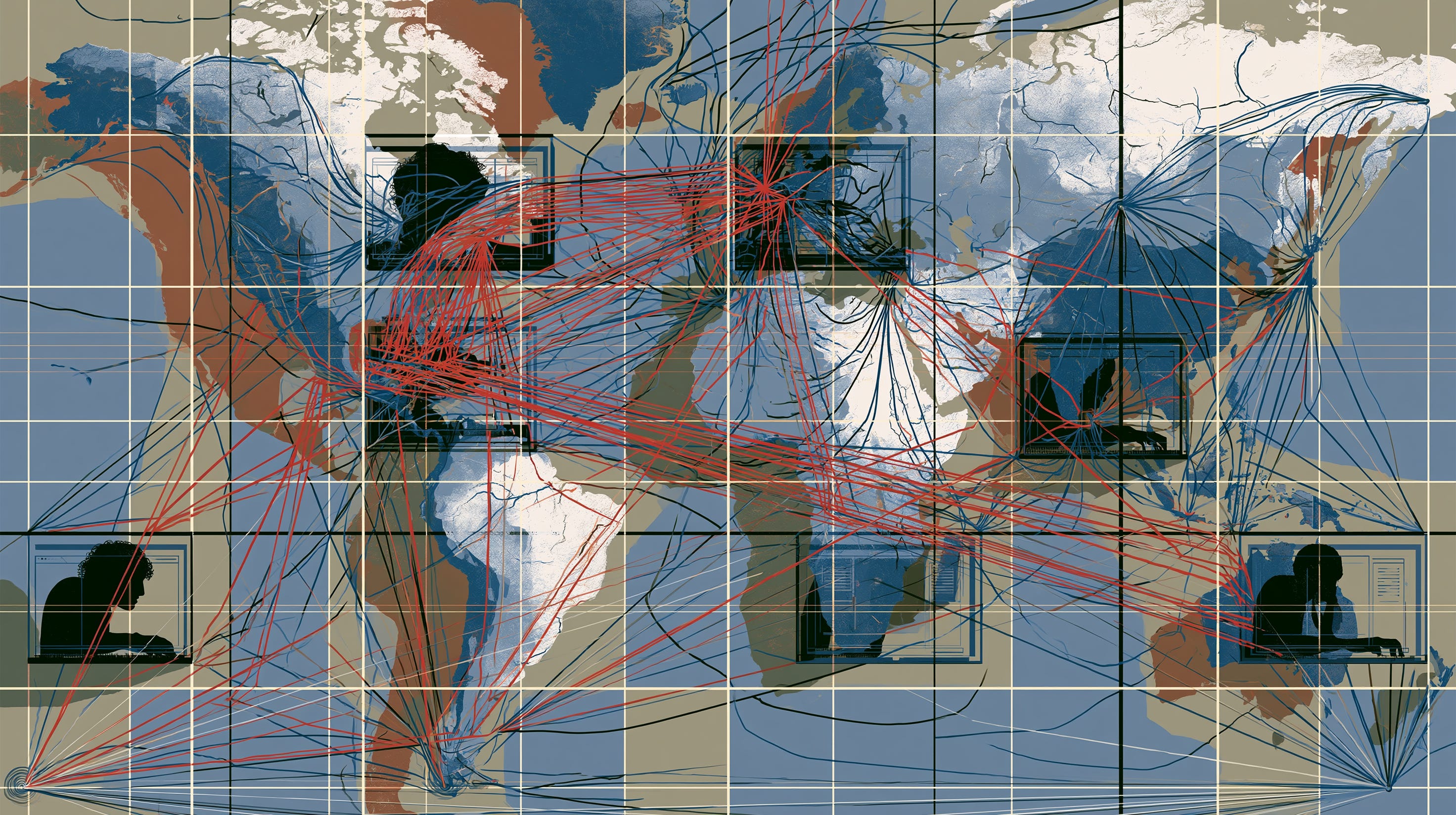
Suppose we actually do it. Suppose we retire the inherited projection, the mosaic of colored territories with its heartland shaded ominously at the center of Eurasia, and draw the world as it operates. The exercise sounds abstract but it is not; the data exists, most of it in plain sight, and the drawing has in effect already been done piecemeal by the people who run clearing systems, insure cargoes, allocate spectrum, and license machine tools. All that remains is to assemble their partial views into one picture and then, crucially, to have the nerve to read what it says.
Begin with the layer where the routing is densest, which is money. The world’s transactions, whatever flags fly over the parties, overwhelmingly seek settlement in a handful of currencies issued by the old maritime coalition and its clients, and they seek it through clearing and messaging systems operated from a handful of cities on that coalition’s territory. The world’s savings behave the same way. When institutions anywhere on earth, including institutions owned by governments hostile to the coalition, need a safe place to store value at scale, they buy the coalition’s debt, because nothing else exists in sufficient depth. The world’s trade cannot move without insurance, and the insurance and reinsurance markets that price planetary risk cluster in two or three postal codes. Even the periphery’s own commerce with itself is largely denominated in, and therefore visible to and interruptible by, the core it defines itself against. A striking share of the lending the challengers extend to their own client states is written in the hegemon’s currency, which means that even the project of building an alternative order runs, at the level of plumbing, through the order it is meant to replace.
Now lay the technology layer over the monetary one. Trace where the irreplaceable inputs of the advanced economy actually come from, not the assembly, which is genuinely distributed, but the nodes without which assembly stops. The machines that make the machines. The lithography, the design software, the instruction sets, the aviation certifications, the pharmaceutical approvals that the world’s regulators copy, the operating systems, the research universities that sit atop the citation graph, and beneath all of it the language, one particular natural language, in which the protocols, the contracts, the journals, and the standards are written. Node after node, the pattern repeats. The high-margin, hard-to-substitute positions, the places where the paths converge, sit inside the same loose civilization that the territorial map depicts as a thin defensive ring clinging to the edges of the world island. Measured by profit share in the industries that constitute the technological frontier, the concentration is not subtle; it approaches the kind of dominance that, were it territorial, would be visible from space and taught to schoolchildren as empire.
Read honestly, the graph says something that a century of strategic cartography has rendered almost unsayable. The maritime coalition did not end up holding the line at the water’s edge. It ended up building, owning, and inhabiting the interior of the world that actually exists. It is the heartland now, in the only sense that still operates: the dense core through which the planet’s value, information, and permission must pass. Mackinder’s pivot materialized after all, assembled over eight decades, mostly by accident, out of settlement rails and standards bodies and university departments and insurance syndicates, and the coalition that built it has been standing inside it the entire time, gazing anxiously outward at the map’s old center, wondering when the siege will begin.
And the continental giants, the powers whose sheer landmass makes them the protagonists of every territorial nightmare? Redrawn as positions rather than places, they sit at the periphery of the graph, and the proof is not in any statistic but in their behavior, because peripheral actors behave in a way that core actors never do. They build alternatives. Consider what the challengers actually spend their strategic energy on, the projects that consume their planning ministries and their summit communiqués. A payment and messaging system to substitute for the one they can be expelled from. A settlement currency project, perpetually announced, to escape the one that can see them. Land corridors and port chains across three continents, a trillion dollars of concrete poured in an attempt to reroute the world’s flows through themselves. Cables laid, satellite constellations lofted, parallel app ecosystems, parallel standards proposals in every technical body that will seat them, national operating systems, national chip programs pursued at any cost, sanction-proofing as a governing philosophy of economic life. Each project is announced as strength, and the inherited map obligingly renders it as the heartland’s dreaded outward surge. But look at the pattern with the new map in hand and the projects confess in unison. Nobody builds a parallel system to a system they command. The construction of alternatives is the signature activity of the excluded. It is what you do when the paths do not run through you, when every transaction, filing, and shipment reminds you that your access to the world’s interior is a revocable privilege administered by someone else. The periphery is not besieging the core. It is tunneling toward it, and announcing each meter of tunnel as a triumph precisely because the distance still to go is unmentionable.
This reading also explains, more economically than ideology ever could, why the challengers cohere at all. The territorial map strains to explain the axis of revisionists, this improbable syndicate of a Leninist party-state, a post-imperial petrostate, a theocracy, and a dynastic garrison kingdom, and usually settles on hand-waving about autocracy. But autocracy is not a foreign policy. What the members actually share is a position: they are the largest actors excluded from the graph’s interior, joined not by what they believe but by where they sit, by the common experience of conducting their affairs through infrastructure that watches them and can be turned against them. Peripherality is their ideology. It requires no doctrinal agreement, which is why their partnership survives having none, and it dissolves the moment any member finds a separate path inward, which is why the core’s diplomats correctly sense that the syndicate is brittle without being able to say, on the old map, exactly why.
There is one great exception to the pattern of peripheral weakness, and it deserves its paragraph, because it proves the new rules rather than breaking them. The challengers hold a small number of genuine positions in the graph, nodes where the world’s paths really do converge on them. The processing of certain minerals is the famous case: not their extraction, which is geology and widely distributed, but their refinement, a foul and capital-hungry industrial layer that the core spent thirty years happily offshoring and that one challenger patiently consolidated. From this modest set of holdings flows a coercive capability out of all proportion to its book value, the ability to halt assembly lines on other continents with a licensing announcement. Notice what this asymmetry teaches. A few genuine chokepoints in the hands of the periphery generate more strategic effect than millions of square kilometers of sovereign territory. The challengers’ own most effective weapon is positional, not territorial, and their skill in wielding it demonstrates that they, at least, can read the new map. They can hardly avoid reading it. They collide with its edges every day.
The new map also explains, in passing, the actors the old map finds most exasperating: the great uncommitted, the continental democracies and oil monarchies that cultivate both blocs with serene shamelessness, buying weapons from one while embedding the other’s telecommunications in their infrastructure, joining every club and pledging to none. On the territorial projection this reads as fence-sitting, a failure of nerve or values awaiting correction. On the graph it reads as the most sophisticated strategy currently being played. These states have grasped, earlier than either principal, that the world is in the interval between maps, and that the rational posture during such an interval is multi-homing: connect to every network that might become the network, keep each connection deep enough to be valuable and shallow enough to be severable, and sell your uncommitted position, again and again, to whichever core bids for it this season. They are not confused about the new geography. They are arbitraging the confusion of others, and the durability of their strategy is itself a measurement, the surest available, of how far from settled the new map remains.
Which brings us to the strangest feature of the whole configuration, the one on which the remainder of this essay turns. The periphery sees the graph clearly, and the core does not. This is not a failure of intelligence in either sense of the word. It is structural, and it has three interlocking mechanisms.
The first is that centrality is ambient. Power exercised through routine does not feel like power; it feels like normality, like the way things simply are. The citizen of the core experiences the graph the way a fish experiences water, as the medium of life rather than an arrangement of it. His currency is just money. His language is just language. His standards are just how things are done, his universities just where one studies, his legal system just where serious contracts go to be enforced. Every one of these is a position, an inheritance of routing built up over a century, and none of them registers as an asset because assets are things you can imagine losing, and the core has not yet imagined it. The periphery, by contrast, enjoys no such anesthesia. The excluded encounter the architecture constantly, at every checkpoint, in every denied license and monitored transfer, and so they know the building far better than its owners do, the way the doorman knows the building better than the penthouse. Clarity about the structure of power is one of the few reliable compensations of not having it.
The second mechanism is the inherited map itself, which does not merely fail to show the core its position but actively assigns it the opposite one. Three generations of strategists in the maritime coalition were trained on a projection in which they are the thin red line, the vulnerable ring, the scattered defenders of the water’s edge against the massed interior. The training took. An establishment schooled for a century in its own encirclement will interpret any data through that expectation, and the expectation is self-sealing: evidence of the challengers’ weakness reads as deception, evidence of their peripheral scrambling reads as the dreaded breakout, and evidence of the core’s own overwhelming centrality reads as nothing at all, because the map has no symbol for it. The old cartography functions, at this point, less as a description than as a phobia with tenure.
The third mechanism is subtler and does the most damage, because it corrupts the numbers themselves. Call it the accounting problem. The core’s ledgers, national and corporate, were designed in the territorial age, and they book every connection as an exposure. A supply chain that terminates in your economy appears in your statistics as dependence on foreigners. A trade deficit, which among other things measures the world’s willingness to send you real goods in exchange for entries in your own ledger, an arrangement emperors would have recognized as tribute, is recorded as a national wound. The migration of routine manufacturing outward, which concentrated the irreplaceable layers inward, is remembered as the day the country stopped making things. Nowhere in the accounts is there a column for position, for the value of being the node through which the paths run, and so the single largest asset on the civilization’s balance sheet is carried at zero. The core is in the position of a landlord who has lost the deed and, finding rent mysteriously appearing in his account each month, concludes that he must be the one being robbed.
Add the three mechanisms together and you get the defining political emotion of the age, which is vertigo. This is where the cartographic lag stops being a thesis about strategy and becomes a description of how the present actually feels, because the lag is not experienced as an idea. It is experienced as a pervasive, low-grade disagreement between instruments and senses, a turbulence in the cabin that no one on the flight deck will acknowledge, and it afflicts the core and the periphery in opposite and equally distorting ways.
In the core, the felt reality is siege. The most structurally dominant civilization in the history of the species, holder of the currency, the frontier, the standards, and the routes, moves through the world with the affect of a losing power: obsessed with decline, fluent in its own obituaries, convinced that it is being overtaken, hollowed, humiliated, replaced. Its politics on every wing is a politics of restoration, differing only on the date of the golden age to be restored. Its public squares churn with the vocabulary of last chances. None of this is irrational, exactly. It is what the old instruments genuinely display. Steering by territory and tonnage, the core really is losing, has been losing for decades, since the ships are built elsewhere, the steel is poured elsewhere, the trade lines run red. The panic is an accurate reading of an obsolete panel. And the tragedy under construction, which the final part of this essay will assemble in full, is that a core which feels itself besieged will reach for siege behaviors, walls and withdrawals and extractions, which happen to be the only class of actions capable of destroying a network core from within.
The core has, in fact, felt this exact vertigo before, and the precedent is worth a moment because it establishes that the emotion is structural rather than contemporary. Edwardian Britain, standing at the absolute zenith of the first networked hegemony, the operator of the cables, the gold standard, the insurance markets, and the sea lanes, was consumed by a panic of decline so florid that its pamphlet literature reads today like parody. The instruments of the age, which measured steel tonnage, wheat acreage, and birth rates, showed Germany and America surging past on every gauge, and the instruments were correct; on the territorial-industrial map, Britain was being overtaken, decisively. What the gauges could not display was that Britain’s actual position, the routing of the world’s money, information, and risk through London, remained so deep that it would take two world wars and half a century of deliberate liquidation to exhaust it. The Edwardian response to the panic was a movement to wall the empire into a tariff bloc, to make the red on the map real again, and the arguments of that campaign, the hollowed industries, the cheating foreigners, the betrayed workingman, the lost greatness one bold protectionist stroke could restore, can be read aloud today, verbatim, into any microphone in the core, to applause. The homesickness is not new. It is what the interior of a network feels when it reads its own dashboard.
In the periphery, the same lag produces the mirror distortion, a confidence as unmoored as the core’s despair. Read on the old map, the challengers are winning, and they know it with the whole of their inherited instincts: territory annexed or claimed, fleets launched by the dozen, industrial output towering, the ring visibly wavering. The periphery’s leaders are, if anything, better students of the classical cartography than their rivals, having come up through systems that teach Mackinder with a straight face, and the map tells them their hour is approaching. Meanwhile their daily collisions with the graph teach the opposite lesson, teach it in frozen reserves and denied machines and watched transactions, and the two teachings cannot be reconciled, so peripheral strategy oscillates in a rhythm the core finds inscrutable: swaggering probes followed by sudden caution, decades of patient tunneling punctuated by gambles that seem to bet the regime on a weekend. It is the behavior of an actor holding two maps that disagree, striding on one and flinching on the other.
And beneath both elites, in the populations, the lag is felt without being understood, which may be the largest political fact of the era. Ordinary people in the core inhabit the disorientation directly. They are told, correctly, that they live in the richest and most capable society ever assembled, and they feel, also correctly, that the ground has somehow gone soft, that the old maps of a life, the ones connecting effort to place to security, no longer pay out where they used to. The official instruments insist that everything is fine while the felt world disagrees, and into that gap between dashboard and windshield flows the politics we now have: the politics of cartographic homesickness. Make the borders real again. Bring the factories home. Restore the map to force, tariff by tariff, wall by wall, as if the world could be legislated back into the projection where it last made sense. The appeal of territorial politics in a post-territorial world is not stupidity, and the analysts who condescend to it misread it badly. It is a comprehension strategy. Territory is the last map everyone can read, the one representation of power that requires no expertise, and a population that senses its elites navigating by instruments no one will explain will predictably reward any leader who promises to burn the instruments and steer by landmarks again.
So the configuration stands complete, and it is perverse from every angle. The core holds the world and feels it slipping. The periphery grasps at the world and mistakes its own tunneling for conquest. The publics of the core demand the restoration of a map their own civilization’s success made obsolete. And everyone’s felt experience, the siege, the swagger, the homesickness, is a faithful reading of instruments that are lying, which is what makes the moment so much more dangerous than simple ignorance ever could. Ignorance hesitates. The falsely instrumented act with conviction.
What remains is the mechanism by which this vertigo becomes catastrophe, and it is not the mechanism anyone is watching for. Network cores are almost never taken. In the whole history of positional power, the dense interior has essentially never fallen to the tunneling of the excluded, because the mathematics of routing defend it: every attempt to route around a true core mostly demonstrates how expensive routing around it is. Cores fall another way. They fall by their own hand, through a sequence so quiet and so locally reasonable at every step that it has never once been recognized while it was happening. The core stops routing. It mistakes its connections for its wounds and begins, prudently, defensively, patriotically, to sever them.
That mechanism, its anatomy, its precedents in the ruins of every network core before this one, and the question of whether a lag has ever been closed in time, is next.
The Abdication Mechanism
Begin with the fact that should be the most famous in the study of power and is instead almost unknown: network cores do not fall to their challengers. Survey the whole record of positional dominance, the cities and systems through which the world’s value and information were made to flow, and you will search in vain for a single case of the dense interior being taken by the excluded, stormed, out-built, or out-tunneled from the periphery. The mathematics of routing forbid it. A true core is defended by every actor who depends on it, which is to say by nearly everyone, because each of them has sunk costs in its protocols, priced its risks in its markets, written its contracts in its language, and would have to bear the expense of migration personally while the benefits of a new order accrued to others. This is why the challengers’ parallel systems remain, decade after decade, announcements more than architectures. The alternative payment rails carry a rounding error of the traffic. The alternative currencies are held by their issuers’ friends, under duress, briefly. The pull of the interior is not sentiment; it is the compounded gravity of everyone else’s prior decisions, and no peripheral power, however vast its territory or fervent its ambition, has ever generated a counter-gravity sufficient to strip a functioning core of its traffic.
The operative word is functioning. Because cores do end. The record is a graveyard of former interiors, cities that once sat at the convergence of the world’s paths and now sit merely at the convergence of tourist itineraries. And in every case, when you perform the autopsy honestly, the wound is self-inflicted. The core was not conquered. It stopped routing. It came, through some sequence of locally reasonable decisions, to treat its connections as its vulnerabilities and its openness as its wound, and it began to sever, toll, and wall, each act prudent in isolation, patriotic in intention, and applauded at the time, until the traffic, which is patient but not loyal, quietly found other ways to flow. Call this the abdication mechanism, and note its cruelest property at the outset: it is invisible on the instruments of the power performing it. Territory registers loss immediately; a province falls and the map bleeds. Routing share erodes in silence. No flag is lowered when a contract is written under someone else’s law, when a shipment is insured in another market, when a talented twenty-four-year-old, weighing two visa regimes, chooses the other one. The dashboard of a self-severing core shows nothing at all, for years, sometimes for decades, and then it shows everything at once.
The anatomy of abdication has four movements, and they arrive in order.
The first is misdiagnosis, which we’ve already established: the accounting problem, the ledger with no column for position, the landlord who reads his rent as robbery. Every subsequent movement follows from this one, because a power that books its connections as exposures will treat the reduction of connection as the definition of safety.
The second movement is extraction, and it is the one currently most advanced. A core that has forgotten why the paths run through it begins to treat its position as a toll booth rather than a thoroughfare. It taxes the traffic, first at the edges, then at the trunk. It charges its own allies for protection it once understood to be an investment in the network’s density. It reaches, more and more casually, for the master switches, freezing this actor’s reserves, expelling that one from the clearing system, conditioning access to its markets and its money on an ever-lengthening scroll of compliance. Each individual exercise is defensible and most are even just. But position is a strange asset: it is spent by being used. Every closure of the chokepoint is also the world’s most persuasive advertisement for the alternatives, a demonstration, staged at the core’s own expense, that dependence on the interior is a liability against which every treasurer, shipper, and sovereign on earth should now prudently hedge. The challengers understood this before the core did, which is why their most effective strategy has never been to build the parallel rails, a task at which they are mediocre, but to bait the core into driving traffic onto them, a task at which the core has proven gifted. The periphery cannot make its tunnels attractive. It can only hope the interior makes itself repellent, and then wait.
The third movement is withdrawal, the severing of the inbound flows. A core’s density is not a stock but a circulation; it is maintained by what arrives, the capital seeking safety, the cargo seeking insurance, and above all the people seeking the frontier, the perpetual inward migration of the ambitious that has been the signature of every interior in history. Talent is the deepest routing of all. The core’s dominance of the knowledge graph, its universities atop the citation networks, its laboratories atop the patent flows, was never a national endowment; it was an artifact of being the place the world’s most driven minds pointed themselves toward, generation after generation, and it survives exactly as long as the pointing does. A core in the grip of siege feeling experiences this inflow as invasion. It narrows the gates, audits the arrivals, teaches its universities to fear their own foreign students and its laboratories to fear their own collaborations, and it experiences each narrowing as hygiene. The traffic does not argue. The twenty-four-year-old does not write a letter of protest. She simply applies elsewhere, and the dashboard, which has no gauge for her, shows nothing.
The fourth movement is the silence itself, the long deceptive plateau during which the severing core appears to suffer no consequence, because the network’s sunk costs defend the incumbent’s position even as the incumbent dismantles its foundations. This is the phase in which the sceptics of decline are, on all visible evidence, correct, and their correctness is the trap. The currency’s share erodes by fractions of a point a year. The conference that must be attended becomes one of two that should be. The default law of contracts becomes a choice of law. Nothing announces itself. The core’s position dies the way the novelist said bankruptcy arrives, gradually and then suddenly, and the suddenly is merely the moment the accumulated gradual becomes common knowledge, when every actor discovers that every other actor has also been quietly hedging, and the coordination that once locked the world into the interior flips sign, in months, and locks it out.
The ruins confirm the anatomy with an almost pedagogical neatness. Venice, the first great chokepoint state, holder of the hinge between Europe and the East, tolled its position harder and harder through the fifteenth century, until the traffic did the arithmetic and financed a route around the entire African continent to escape it; the Cape passage was not a discovery so much as an eviction notice, served by the world’s cargo on an interior that had confused its convergence of paths with a law of nature. Ming China performs the purest case, so pure it reads as fable: the most central economy on earth, operator of treasure fleets beside which the caravels of the periphery were rowboats, chose, in a sequence of deliberate imperial decisions, to burn the fleets, ban the ocean, and wall the interior, booking its own connectivity as contamination. The traffic did not mourn. It rerouted through the hands of the tiny, violent, peripheral states of Atlantic Europe, and the graph those states then wove, over four centuries, became the world in which China would later be made to trade at gunpoint. Amsterdam, having built the first modern financial interior, drifted into rentierism, its capital preferring to lend abroad at interest rather than route enterprise at home, and its position passed, without a decisive battle, to London, which had made itself the more open port. And London in its turn liquidated the deepest positional inheritance ever assembled, through two wars it could not avoid and a long imperial retreat it partly chose, watching the world’s settlement migrate to New York over the space of a single working lifetime. Four cores, four abdications, and not one of them fell to its rivals. Venice was routed around because it over-tolled. Ming severed itself. Amsterdam stopped circulating. London bled out and closed. The periphery, in every case, merely inherited.
There is a reason the fatal course is not merely permitted by the old map but propelled by the deep structure of politics itself, and it deserves naming, because it explains why no faction is immune. Severance is legible and routing is not. A wall photographs. A tariff has a number. A reshored factory has a ribbon, a governor, a hard hat for the cameras. The maintenance of position produces no images at all: there is no ceremony for the contract that continued to be written under your law, no ribbon for the settlement that kept clearing through your rails, no anniversary of the student who came and stayed and founded something a decade later. Democratic politics runs on the visible, and the entire yield of centrality is invisible by construction, a vast harvest of events that fail to happen elsewhere. The result is a standing electoral subsidy for abdication, in every party, in every core, in every era. Venice’s tolls had constituencies. The Ming sea ban had scholars who argued for it beautifully. The Edwardian tariff campaign filled halls that free trade could never fill, because you cannot fill a hall with the absence of a catastrophe. Whoever proposes to spend real, countable money maintaining an advantage no gauge can display will lose the argument to whoever proposes to stop being cheated, every time, until the decade when the gauges finally move, by which point the argument is over in a different sense.
Set the anatomy beside the present and the reading is uncomfortable in the way only structural readings can be, indicting no faction because it indicts a configuration. The reigning core is currently performing all four movements at once, each with broad support, each in response to genuine grievances, each locally defensible. It tolls its own alliance network and calls it fairness. It reaches for the financial master switches at a tempo that has made de-risking from its own rails the official policy of friend and foe alike, and calls it strength. It narrows the gates through which the world’s ambition has poured toward it for a century, and calls it security. And its instruments, which measure factories and tonnage and terrain, register these severances as recoveries, because on the old map they are recoveries. The territorial gauges genuinely improve as the positional foundation erodes. This is the specific perversity of a cartographic lag at the moment of maximum danger: the map does not merely fail to warn against the fatal course. It rewards it.
Is the course ever corrected? The record offers exactly two kinds of hope, and it is worth being precise about both, because false hope is the last service an essay like this should perform.
The first is that lags have been closed by the periphery under pressure, which proves closure is possible at all. The canonical case is Meiji Japan, an entire ruling class that, confronted with unanswerable evidence that its map of the world was obsolete, chose, within a single decade, to burn the map rather than the evidence. What makes the case remarkable is not the modernization, which others attempted, but the cartographic honesty that preceded it: the systematic dispatch of the Iwakura mission to survey the actual structure of the world’s power, the unsentimental inventory of which native institutions were load-bearing and which were furniture, the redrawing of everything from the calendar to the constitution around the world as it operated rather than as inherited pride depicted it. Japan closed a civilizational lag in roughly twenty years because its elite performed the one act that lag forbids: it granted the territory authority over the map.
The second hope is closer to home, and it is the buried irony on which this entire configuration rests. The present core did not inherit its position. It drew it. The interior of the network world was designed, deliberately, on paper, in a burst of conscious cartography in the middle of the twentieth century, by a generation of Americans and exiles who had just watched a cartographic lag, the interwar decade of gold-standard orthodoxy and beggar-thy-neighbor walls, incinerate the world they were born into. The settlement they built at Bretton Woods and after, the currency architecture, the trade rounds, the alliance webs, the open scientific commons that vacuumed the world’s talent toward American laboratories, was not the spontaneous product of victory. It was a theory of position, held by men who had learned at catastrophic expense that centrality is a verb, that the interior belongs to whoever keeps the paths open and pays the costs of keeping them, and that the alternative to routing the world is being routed around by it. The founders of the current core were, in other words, the most successful map-redrawers in history. Their heirs have kept the position and lost the theory, and now stand inside the cathedral those men built, complaining about the cost of the candles.
What would it mean, concretely, for the present core to close its lag while the closing is still cheap? Not a program, which is beyond an essay’s competence, but a criterion, which is not. It would mean putting position on the ledger: learning to count, and to say aloud, what the old instruments cannot, so that the invisible harvest has defenders with numbers of their own. It would mean rationing the master switches like the exhaustible ordnance they are, spending the chokepoint only where the object is worth teaching the whole world another lesson in hedging. It would mean treating openness, to traffic, capital, and above all talent, not as a sentiment to be balanced against security but as the security, the load-bearing infrastructure of centrality, maintained the way a port city maintains its harbor, which is to say expensively, unsentimentally, and forever. None of this requires the core to be generous, and the point is badly made whenever it is made as moralism. It requires only that the core want to keep what it has, and know what that is.
Pull back, finally, from geopolitics altogether, because the condition was never confined there, and the reader has likely spent much of this essay recognizing it elsewhere. Cartographic lag is fractal. It reproduces at every scale at which humans steer by representations, which is every scale there is. The corporation that dominates its industry’s old map, patiently optimizing market share in a category its customers have already begun to leave, is running the mechanism in miniature, and its final quarters will show record margins, because extraction is what a dying position does best. The economic dashboards of nations, the output and employment gauges designed in the 1940s to render an economy of foundries and payrolls, go on rendering it, faithfully reporting the temperature of an engine the vehicle no longer runs on, which is why the era’s signature economic sensation is the one this publication has examined before: numbers that insist on health, felt experience that insists otherwise, and a public that trusts its senses and concludes, not unreasonably, that someone is lying. And beneath all of it, at the scale of the single life, every reader navigates by a private cartography, the inherited map of how effort becomes security, credentials become careers, decades become a shape, drawn by parents for a territory that has since moved. The low-grade dread that hums under contemporary life, the sourceless sense of standing on ground that has not yet admitted it is falling, is what the interval between maps feels like from inside a person. It is the vertigo of the second part of this essay, miniaturized and made intimate. We are not anxious because we are weak. We are anxious because we are navigating honestly with instruments we correctly suspect, and the two available anesthetics, clinging to the old map with fundamentalist grip or pretending to a new one no one has actually drawn, are both more dangerous than the vertigo they treat.
Which returns us, as it must, to the lecture hall on Savile Row, and to what Mackinder was actually doing on that January evening, because a century of his disciples have gotten it exactly backwards. Mackinder is remembered as the man who drew the heartland, the author of the answer, and the answer is what the staff colleges preserved, embalmed, and eventually mistook for the earth itself. But the answer was the least of what happened in that room. What happened in that room was that a man stood before the high priesthood of the old map, the explorers and colonial surveyors whose entire cosmology assumed an open world with blank space at the margins, and told them the world had closed, their map’s deep premise had expired, and the whole architecture of significance would have to be drawn again from nothing. He was not opening the lag we live in. He was closing the one they lived in. The lecture was an act of cartographic revolt, and its tragedy is the tragedy of every successful map: it worked, so it was kept, and it was kept so long that it became, for its inheritors, precisely the kind of dead premise its author had stood up to kill.
The lesson of the century, then, is not the heartland, and it was never the rimland. The lesson is the question Mackinder asked and his disciples stopped asking: in a closed system, where do the paths run now? Every generation the world’s structure moves; every generation the question must be put again, freshly, with the nerve to accept an inverted answer. The powers that survive transitions are never the strongest on the old map or the boldest on the new one. They are simply the first to redraw, the first elites willing to grant the territory authority over the map while the map is still paying dividends, which is the hardest act of governance there is, because it requires a civilization at the height of its instruments to trust its vertigo instead.
Somewhere, right now, in some seminar room or planning ministry or unread journal, the next map is being drawn. It will look wrong. The genuinely new map always looks wrong; that is how you know it is not the old one. The only open question, the one on which the fate of the present interior turns, is the oldest question in the history of steering: whether the powers that be will read it while there is still time to change course, or whether, like every abdicated core before them, they will have it read to them, afterward, as an autopsy.
End.
Amazing work, as always
Brilliant piece. Than you.